

Freshwater vs. Saltwater Pearls: What’s the Difference?
Pearls are one of the few gemstones created by a living organism (along with amber and jet).
All pearls form inside mollusks when layers of nacre—the same iridescent material that lines the inside of a shell—build around an irritant or an intentionally introduced piece of tissue or nucleus. A common misconception is that the irritant is sand. While that is sometimes the case, it’s usually a tiny parasite 😅
I digress.
But! Not all pearls form in the same way or even in the same animals.
If you've ever wondered about the difference between freshwater and saltwater pearls, you're not alone. The names make the differences sound pretty straightforward, but they go beyond simply “one comes from a lake and one comes from the ocean.”
So what actually makes them different? And if you're shopping with sustainability in mind, does one make a better choice?
Let's dive in 🌊
What Is a Freshwater Pearl?
Freshwater pearls are cultured in freshwater environments (duh), including lakes, rivers, and ponds.
They are most commonly produced by freshwater mussels (commonly Hyriopsis spp.), with China being the world's largest producer of freshwater cultured pearls.
One of the biggest differences between freshwater and saltwater pearl cultivation is how the pearl is started.
Freshwater pearls are typically cultured using a small piece of donor mantle tissue rather than a large bead nucleus. The mussel then deposits layers of nacre around that tissue as the pearl develops.
The result is a pearl made almost entirely of nacre.
Freshwater pearls can come in an incredible variety of shapes and colors, including:
- Round and nearly round
- Oval
- Button-shaped
- Rice-shaped
- Elongated
- Baroque, or irregularly shaped
That variety is one of the things I love most about freshwater pearls. Instead of uniformity across pearls, you get subtle, and sometimes dramatic, differences that make each one feel special and unique (just like you).
What Is a Saltwater Pearl?
Saltwater pearls are cultured in marine environments and are generally produced by oysters.
Some of the best-known types include:
- Akoya pearls - Japan and China
- Tahitian pearls (my fav)
- South Sea pearls - Australia, Indonesia, Philippines
Saltwater pearl cultivation typically involves implanting a bead nucleus along with a small piece of mantle tissue into an oyster. The oyster then coats the nucleus with layers of nacre over time.
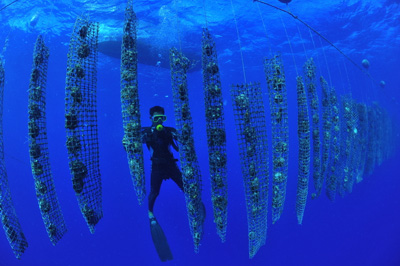
Tahitian pearl oyster and pearl cultivation. Photo: Tahiti Tourisme / Philippe Bacchet.
The thickness and quality of those nacre layers contribute to the pearl's appearance, luster, durability, and price.
Saltwater pearls are often associated with the classic, perfectly round pearl necklace, but they can also be baroque or otherwise irregularly shaped.
Freshwater vs. Saltwater Pearls: What's the Difference?
The simplest difference is where the mollusk lives, and what type of mollusk it is.
But there are several other, very important differences.
| Freshwater Pearls | Saltwater Pearls | |
|---|---|---|
| Mollusk | Freshwater mussel | Marine oyster |
| Environment | Lakes, rivers & ponds | Ocean |
| Cultivation | Usually tissue-nucleated | Usually bead- and tissue-nucleated |
| Nacre | Almost entirely nacre | Nacre surrounding a bead nucleus |
| Shapes | Very varied | Often more consistently round, depending on type |
| Colors | White, pink, peach, lavender & more | White, cream, silver, gray, black & more |
| Common types | Freshwater cultured pearls in Asia | Akoya, Tahitian & South Sea |
| Price | Often more accessible | Often more expensive |
Neither type is inherently “better.” They simply have different characteristics that can make one a better fit for a particular piece of jewelry or personal style (or price point).
Why Do Freshwater Pearls Come in So Many Shapes?
This is one of my favorite things about freshwater pearls.
Because freshwater pearls are typically cultured using mantle tissue rather than a large bead nucleus, the resulting pearls tend to have more varied shapes. And luckily for us, nacre doesn't always form a perfect sphere.
Instead, you can get all kinds of wonderfully weird shapes and blemishes.
Some freshwater pearls are perfectly round while others look like little grains of rice, coins, sticks, or abstract sculptures.
I love this because it is a reminder that natural materials don't have to be perfectly uniform to be beautiful. In fact, I think the variation is part of the charm.
Are Freshwater Pearls Real Pearls?
Yes!
This is one of the most common misconceptions about freshwater pearls. “Freshwater” does not mean “fake,” and freshwater pearls are not imitation pearls. They are genuine pearls produced by living freshwater mussels.
But there's another pearl distinction that's worth knowing: natural vs. cultured.
These terms describe how a pearl begins forming, rather than whether the pearl is “real.” And the story behind that distinction is a fascinating one, especially because almost all pearls used in modern jewelry are cultured.
I'll be diving deeper into natural vs. cultured pearls in an upcoming Scallop Journal post, including how each type forms, why natural pearls are so rare, and what “cultured” actually means. So stay tuned for that!
Are Freshwater Pearls More Sustainable?
This is where things get a little more complicated and the answer is not straightforward.
It can be tempting, and even compelling, to say that freshwater pearls are automatically more sustainable than saltwater pearls—or vice versa. But sustainability doesn't work quite that simply.
A pearl's cultivation environment doesn't tell you the entire story.
Pearl farming can support coastal economies while producing a natural gemstone without some of the environmental impacts associated with traditional mining. We love that!
Mollusks in both environments depend on relatively healthy habitats, making environmental conditions an important part of successful pearl cultivation. I say "relatively healthy" because mollusks are filter feeders, meaning they actually filter water to eat. Their filter-feeding can remove particles from the water and, under the right conditions, contribute to improved water quality. Mollusks are extremely cool.
However, pearl farming isn't automatically sustainable simply because the pearls are cultured (or "farmed") and they inherently improve water quality.
Other things like:
- Farm density
- Habitat disturbance
- Waste management
- Chemical use
- Energy use
- Labor practices
- Local environmental regulations
can all matter.
In other words, “cultured” tells you how a pearl was produced, not whether the entire operation was environmentally or socially responsible.
That's why transparency matters more than anything.
How Can You Shop for Pearls More Responsibly?
If you're looking for pearl jewelry with sustainability in mind, don't stop at the words “freshwater” or “saltwater”, or even if a brand claims they are sustainable (anyone can say that).
Instead, ask a few additional questions:
Where were the pearls grown?
A transparent jewelry company should be able to tell you something about where its pearls come from.
Who grew them?
Small-scale and family-owned farms can offer a different sourcing model than anonymous, mass-market supply chains. But farm size alone doesn't tell you whether a farm is environmentally or socially responsible, transparency about farming practices matters most.
Does the brand explain its materials?
THIS IS SO IMPORTANT. If a company makes sustainability a major part of its marketing but provides no information about sourcing, that's worth questioning. No transparency page or sourcing statement? That’s a huge red flag.
Is the jewelry designed to last?
Sustainability doesn't end with sourcing.
A piece that is well made, wearable, and likely to stay in your jewelry box for years has a very different lifecycle from something produced quickly and designed around a single trend.
As I wrote in my guide to what actually makes jewelry sustainable, the material itself is only one part of the equation.
Freshwater Pearls at Scallop Design Co.
At Scallop Design Co., I use sustainably grown freshwater pearls sourced through small, family-owned aquaculture farms (check out my transparency page) AND old stock or vintage pearls (freshwater and marine).
You can explore my pearl collection to see how these pearls show up in our jewelry.
From everyday pearl huggies to more unusual and unique designs, the goal is the same: create pieces that celebrate the ocean without unnecessarily taking from it.
Freshwater or Saltwater: Which Pearl Should You Buy?
Honestly? The one you love! And whose pricing and sourcing you feel good about.
If you love perfectly round, luminous pearls, a saltwater variety like Akoya may be your style. If you love unusual shapes, natural variation, and a more organic look, freshwater pearls are a beautiful option.
And if sustainability is important to you, don't assume that one category automatically wins. Instead, look for transparent sourcing, responsible production, quality construction, and designs you'll actually wear for years.
The Bottom Line
Freshwater and saltwater pearls are both real pearls, but they come from different organisms, environments, and cultivation methods.
Freshwater pearls are generally produced by mussels in freshwater environments, while saltwater pearls are produced by oysters in marine environments.
Freshwater pearls are especially known for their incredible variety of shapes and colors, while many saltwater pearls are prized for their roundness, luster, and rarity.
But when it comes to sustainability, the type of pearl is only part of the story.
The most important question isn't simply freshwater or saltwater?
It's: Where did this pearl come from?
The more we know about the materials we buy, the easier it becomes to support the people and practices doing things thoughtfully.
And that's something worth diving into. 🐚
XO,
Scallop Design Co.